by Dk Siti Zulaikha Pg Hj Ishak. Writing training.
Volcanoes are not merely geological formations; they are cosmopolitical sites where faith, governance, and ecology interweave. Across cultures, volcanoes have served as sacred barometers of moral order, demanding reverence, sacrifice, and political mediation. Drawing from news articles, historical, and mythological sources, this piece explores how communities have made meaning of volcanic activity, oscillating between reverence and destruction.
Om Swastiastu, Om Shanti, Shanti Shanti, Om.
Age-old Sanskrit mantras leave the lips of Jero Mangku Darma, eyes closed, sat cross-legged, beneath the pulsating mouth of Bali’s Mount Agung. By the holiest mountain of the island, on the trembling cross-section of spirituality and mortality, betel leaves and yellow rice accompany the smoke from burnt joss sticks placed in front of a pagoda. A pemangku, or juru kunci (caretaker) of Mount Agung, Jero poses as one of the many temple guardians which the Balinese believe possess the ability to communicate with mountain deities, demons, and spirits. It is 2017, and his little village of Badeg Dukuh, shook haphazardly.
Undeterred, hands clasping incense sticks, firm, Jero continues.
Protect us, grant us safety, endless bounty, the best guidance.
Pungent sulphur is in the air. At the volcano’s base, 72, 000 people have been displaced and evacuated. Yet Jero will not leave; he will search for clues within the fire, smoke, and rocks for signs of divine communication, as other pemangkus have done before him.
From reverence to fear, fear to curiosity, these magnificent leviathans of nature have proven to be a constant source of fascination to mankind. Today, society continues to design increasingly complex lightning-rods of tension between tradition, modernity, and religion, pulling at old beliefs and causing vulnerability to the science that seeks negotiation for better understanding and mitigation. Has our relationship with volcanoes evolved over the centuries?
Sitting in the foci of magical power and supernatural forces, volcanoes play an almost autocratic role within cosmologies. Spawning everything from ancient mythology, sacrificial rituals to harnessing geothermal prowess – volcanoes paint themselves as one of mankind’s most volatile relationships with nature. Legends and superstitions fasten the hems of volcanic regions, placing hyperreal gods, goddesses, and mythical creatures at the root of eruptions. For these beliefs, the contrast of macro and micro analogies often pays tribute to both destructive and fertile forces of eruptions, with some interpreting these events as blessings and others, as punishments for which they need to seek forgiveness for.
The earliest recording of a volcanic eruption is sourced by some from a cave painting dating back to 7 000 BC, at the Neolithic site now known as Çatalhöyük in Anatolia, Turkey. 6, 000 years later, the 1620 BC recording of spectacular eruptions that sent 100ft tsunamis racing across the Aegan Sea produced myths of Poseidon’s wrath. At the turn of the 7th century, German astronomer and mathematician Johannes Kepler declared that volcanoes were in fact, ducts for the Earth’s tears. The shift from poetic dimensions to scientific observation came 1, 200 years later; nowadays, quantum leaps in science and engineering have a shaped a more sophisticated understanding of vulcanology, expanding studies of seismic activity and tectonic plate movements to fit accordingly into science classes across the world.
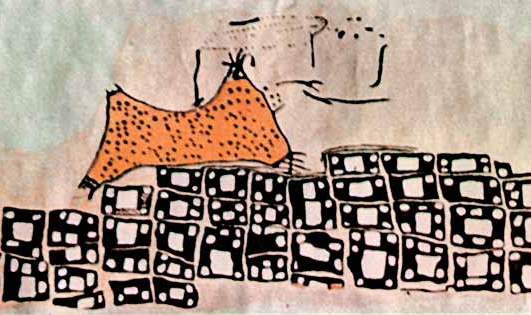 This Çatalhöyük mural is thought to represent a nearby volcanic eruption. New scientific evidence confirms a contemporaneous eruption at nearby Hasan Dağ (Wiener, 2020).
Often, these contemporary studies of natural disasters and hazards research neither the volcanic interpretation of affected people nor of its symbology within cultures; yet it is this very dynamism that negotiates the conceptualization and structuring of eruptions into changeable contexts parallel to human society. When anthropomorphized, cosmos, morality, and social conduct become intertwined: the dictation of human conduct and behavior becomes deeply steeped in determining the fate of volcanoes. For many regions of the world, volcanoes are not only seen as seismographs mapping tectonic-plate movements, but also social harmony and disharmony. Spirit cults, ancestor worship, spirit healing and shamanistic forms (‘dukunisme’) are widespread and enjoy popular support throughout the world; eruptions along these regions often pose risks of revitalizing fanciful myths and beliefs, dismissing efforts to have inhabitants migrate away, and attracting worshippers instead.
The region of Southeast Asia is painted vividly with colours of these motifs; in religiopolitical realms where the cosmos is believed to mirror reality, rulers of the region have long constructed their legitimization through mystical connections with volcanoes. Indeed, the historical mandates for political authority intricately connected the role of the ruler as divine mediators of the living universe. In a balancing perspective, calamities were quickly interpreted as an indication of political injustice and signs for upheaval to rid the ruler of his power. In Java, the volcanic mysticism personifies the volcano as Mbah Merapi (or Grandfather Merapi), a powerful deity viewed to rest at the center of the universe. The elected gatekeeper of the volcano, 83-year old jurukunci Mbah Maridjan, is viewed as an equal to the King through the lens of traditional Javanese Kejawen (religion). In turn, he serves as the conduit for the Sultan of Yogyakarta – “the Carrier of the Universe” – in annual rituals, carried out beneath a patina of Islam to maintain harmony between the mountains, the palace, and the mythical Queen of the South Sea, Nyai Roro Kidul.
Throughout time, there has been the emergence of similar stories in which people from different parts of the globe create parallel worlds. This is the case for repeated fables of giants or ghosts, sitting inside the volcano and cooking meals for the neighbor mountains, their lovers or husbands; the Inerie Volcano of Flores Island and Hekla volcano of Island share these origins. When the 23rd of August arrives to the Vesuv region of Rome, people would cast living fish caught from the Tiber river to appease the God of Fire, Volcanus. This annual festival, Volcania, draws stark similarity to the fish sacrifices practiced today on Mount Lewotobi Perempuan of Flores Island, Indonesia. Though most practices comprise only of dances and prayers as an accompaniment to offerings, historical records also document the sacrificial ritual of young children fed to the heart of volcanoes. In varied versions, sacrificial rituals demand animal slaughters; the Oldonyo Lengai Maasai trIbe of Tanzania offers sheep and goats to their God, Engai. More vividly, Lewtobi Perempuan’s volcanic twin, Lewotobi Laki-Laki, orders a small goat to be ripped apart by worshippers with bare hands. These days sacrifices as these have lessened in the documentation but are still practiced frequently in secret.
Beyond renowned notoriety surrounding deaths, volcanoes are additionally considered in gender categories, depending on the kinship and political organization of the local population. Icelandic folktales concerning volcanoes often concentrate around the tale of Mount Katla and the wicked female cook of þykkvabæjarklaustur monastery. After killing a shepherd who had stolen her magic trousers, she flung herself into a dark crevasse within the ice cap. Ever since, she avenges her fate by pouring fire and water into nearby regions. In most cases across the world, two or more volcanoes that are located next to each other often issue mythologies of love or war. The story of Popocatepetl and Iztaccihuatl in Mexico paints such a theme: retelling the lives of an Aztec warrior who was in love with the emperor’s daughter. Mistakenly informed that Popocatepetl died at war, Iztaccihuatl promptly killed herself. Overcome with grief at his return, Popocatepetl built a mound and laid her body on it, vowing to never leave her again. Today, the people of Pueble worship the saint San Gregoria Chino in bringing him offerings such as flowers and fruits to the slopes of Popocateptl, where the geological formation inspires an image of a womanly figure, depicting Iztaccihuatl, lying on her back, covered with a white sheet of snow as Popocateptl stands eternally at her feet, watching over her.
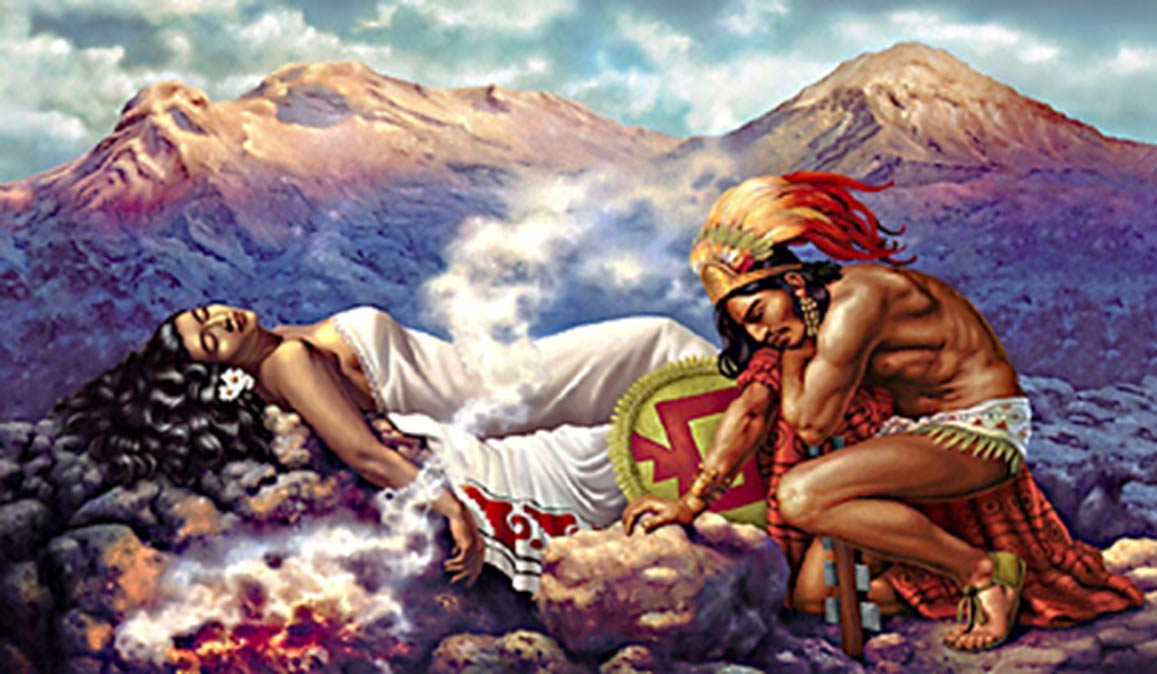 Iztaccíhuatl and Popocatépetl (Klimczak, 2016).
Intersections of science and religion wage passion bolder than ever before: even as scientific knowledge gently pushes the boundaries of volcanic research and geothermal engineering, many people filter their response to volcanic events through the lens of their own experience and belief. The volcanic soils and inviting terrains continue to seduce people to live along the Ring of Fire. In actuality, bolder pages of volcanic calamities serve only to emphasize that they are – more than anything else – very real geological features of the Earth that carry very real danger.
Jero Mangku Sabda, the father of Jero Mangku Darma, and former caretaker of the volcano, was killed with his wife alongside 1000 others during the 1963 eruption of Mount Agung.
Mbah Maridjan, the famed spiritual keeper of Java’s Mount Merapi, was found caked in white soot and prostrating in the typical Islamic prayer position when the 2010 eruption sent searing rivers of lava, gas, ash, and house-sized boulders down the mountain at 724km/h, akin to the speed of a jet aircraft.
Back at Badeg Dukuh, Jero soothes his lava-burnt shins of the 1963 eruption — planning another trek up to the summit; one that will take him at least three hours to make an offering to the spirits. He talks of the men adn women who were burnt by lightning strikes, hot water and ash — as they received the eruptions with strikes of the gong in their gamelan ensemble.
If volcanic cosmologies were once used to negotiate power and fate, do they now serve as acts of resistance against modernity’s epistemic erasures? Or do they reveal that, despite all our scientific advancements, our existential awe and fear of the earth’s violent breath remains unchanged?
Images:
Featured image: Arculus, R. (2017). https://www.swellnet.com/news/swellnet-dispatch/2017/09/22/balis-mount-agung-threatens-erupt
Story of Jero Mangku Darma extracted from: https://www.straitstimes.com/asia/se-asia/risking-death-as-volcano-guardian, https://www.razor.tv/video/spiritual-guardian-at-mt-agung-refuses-to-evacuate/4800266888001/5690360755001, https://www.liputan6.com/news/read/3117042/video-menegangkan-warga-ini-selamat-dari-letusan-gunung-agung-tahun-1963, https://www.cnnindonesia.com/nasional/20171003133427-22-245793/foto-jro-mangku-dharma-sang-penjaga-gunung-agung
Çatalhöyük mural: Wiener, N. (2020). https://www.biblicalarchaeology.org/daily/news/catalhoyuk-mural-the-earliest-representation-of-a-volcanic-eruption/
Iztaccíhuatl and Popocatépetl: Klimczak, N. (2016). https://www.ancient-origins.net/myths-legends/popocatepetl-and-iztaccihuatl-tragic-romance-aztec-legend-005779
 zulaikha Ishak