by Dk Siti Zulaikha Pg Hj Ishak
The Interweaving Nature of Subak System
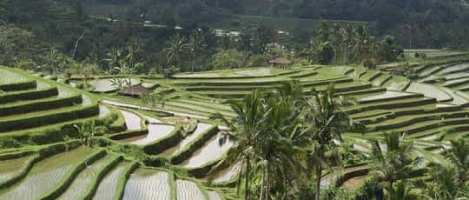
Splashed across the likes of Lonely Planet booklets and Global Trekker articles, photographs of Bali feed tales of verdant exoticism of the island; from dancers frozen in angular and dynamic poses during Wayang Wong, men sat entranced in concentric circles adorned with checked cloths around their waists during a dramatic Kecak retelling, to chains of sea temples adorning the south-western coast of Tanah Lot set dramatically against the waves. Yet perhaps the most prolific synonymity of Bali lies within the glistening meanders of rice terraces that contour the land, from heights of mountain craters to the mouth of rivers. Balinese farmers have long played a historical role in carving the face of the island as we know it today; terraces of ladang padi (or rice-paddy fields) embellish hillslopes throughout, showcasing olden but sophisticated technology based on elevation angles, gravitational hydrology, and nutrient cycling (Huang, 2019; Roth, 2011; Lorenzen & Roth, 2015). The backbone of life in Bali rests amidst these fields; socio-cultural, agroecological and political-administrative forces on the island are influenced by how well the water-irrigation system of the paddy-fields function, and day-to-day activities rely on this landscape for an array of factors. These factors, as expressed by Lorenzen & Lorenzen during the International Rice Conference of 2005, are found in the units that make-up the fields – the technological unit comprising of dams and irrigation canals; the physical unit which contains the rice terraces within defined boundaries, the social unit which includes the farmers, the religious unit which lies in the rituals performed within the landscape, and the legal unit that takes shape in traditional customary law known as awig-awig, outlining the rights and responsibilities of the community in taking care of the landscape (Rahmi & Setiawan, 2020; Huang, 2019).
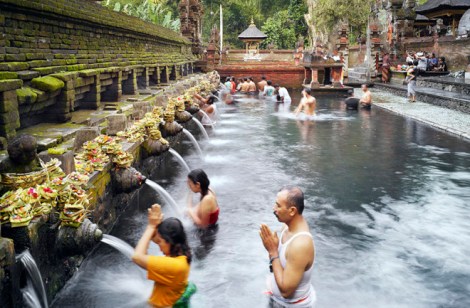
Balinese bathe in the sacred springs of Tirtha Empul. This water also irrigates Perasi’s subaks (Williams, 2014).
So strong is the communal force surrounding the landscape, that the socio-religious organisations form an integral existential element of the irrigation management, called Subak (Huang, 2019; Rahmi & Setiawan, 2020; Wardana, 2015). The Subak system has evolved and adapted correspondingly with dynamic changes in the social fabric of Balinese villages (desa) over the century, regulated by the hamlet (banjar) and temple congregation (pemaksan) in addressing the cultivation and irrigation of rice (Geertz, 1980; Lorenzen & Lorenzen, 2005). The pekaseh holds the role as head of subak, assisted by several democratically elected members, policing cultivation schedules and rituals meant to appease the rice goddesses, Dewi Sri and Dewi Danu. The congregation of worshippers, pemaksan, are sprinkled with trita (holy water) on the heads and hands, and rice grains consecrated with holy water are placed on the forehead, throat and in the mouth for attainment of wisdom, happiness, and prosperity during a Galungan ritual (Huang, 2019; Lansing & Kremer, 1993).
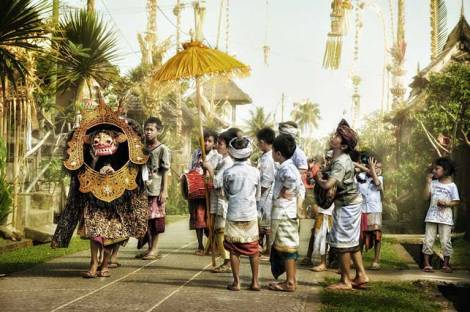
Galungan procession (Priyoga, 2014).
Yet, important rituals as these are seldom illustrated in promotions of Bali rice terraces (see lonelyplanet,travelandleisure & balimagictour) despite making up the fundamental core of sacred Balinese life. This oversight is an alarming cause of misplaced priority in the processes of protecting and promoting the landscape, superficializing the depth of the values embedded within Subak and glamorizing the spaces instead as a photogenic backdrop. Today, three sites are recognized under the World Heritage Site, including Subak Dnun Batur, Subak Pakerisan, and Subak Catur Anggu Batukaru/Jatiluwih (Rahmi & Setiawan, 2020; Lorenzen & Roth, 2015).
i. Guiding principles of Tri Hita Karana, and the sacredness of rice and water in the Balinese desa
Myriad rituals in Bali of propitiating ancestral spirits of water, fire, earth and sun, of the mountains and the sea, of gods and demons reflect a root in orthodox Brahmanic-Sanskrit Hiduism. It is the most distinguishable characteristic of Bali’s Agama Dharma; a hybridization between the animistic beliefs of the island and Indian Hinduism, creating a unique traditionalist ritualism not found anywhere else in the world. The processes within a subak system are guided by a Balinese philosophy derived from the localization of Hindu religion (hereafter referred to as Agama Dharma), known as Tri Hita Karana (THK) (Huang, 2019; Rahmi & Setiawan, 2020; Sutawan, 2004). It seeks a balanced relationship between God, nature, and man, manifested by the subak landscape. Since the 11the century, the ecological basin within which the subaks are carved have been guided by THK, outlined by three pillars; Parhyangan, the relationship between man and God, Palemahan, the relationship between man and natural environment, and Pawongan, the relationship between man and man (Artha et al., 2005; Sutawan, 2004; Huang, 2019; Lanya et al., 2017).

Mission & Vision of THK (Balispiritfestival, 2022).
With Tri translated as three, Hita as happiness and Karana as cause, the philosophy quite literally translates that only with harmony between these three pillars can subak be managed well, and happiness be achieved. In the daily activities of the subak landscape, these three pillars come to life; parhyangan comes in the form of rituals and prayers held at the Pura Subak (water temples), palemahan is expressed in the sophisticated irrigation systems and rice fields, and pawongan is encapsulated by Krama Subak (subak members) in the form of an autonomous network of allocated tasks (Artha et al, 2005; Huang, 2019). These activities complete the THK philosophy and have done so throughout history – archaeological findings point to evidence of rice cultivation in Bali from two thousand years ago (Bellwood et al., 1992). Embedded deep within Balinese traditional belief is the idea that a goddess bequeathed rice to humans and taught them to grow it; that the Balinese rice plant is a sacred symbolization of Dewi Sri, thus celebrations of the goddess are held during rice cultivation cycles to evoke gratitude to her. As described by Huang (2019), rice stalk figures of Dewi Sri are constructed in the form of two triangles with points touching, called a Cili. These figures are carried to the rice ‘barn’, lumbung where daily offerings will be made to request her protection. At these rice-field shrines, rituals are also held to mark water opening, rice field preparation, rice transplanting, growth, first appearance, flowering and harvesting – whereupon completion, priests would don rice on worshipper’s forehead to confirm that they have delivered their devotion to Dewi Sri that day (Ahuja & Ahuja, 2010).
Dewi Sri is not an isolated goddess in the subak – she is often accompanied in prayers by Dewi Danu, the goddess of water who rule over Mount Batur, the cosmic Mount Meru, and Pretiwi, the goddess of the earth (Huang, 2019; Lanya, 2017). Intriguingly, while much of the practices in Balinese daily life are rooted in Hinduism, the traditional Balinese religion called ‘agama tirtha’ (translated as the religion of holy water) is still evident in practice. In agama tirtha, water is sacred and represented by many terms that reflect how it is used – for example, yeh for consumption, amerta for healing and tirtha for holy water – to the worshippers, water is essential in purification and removal of pollution. Henceforth, the flow of water is an integral part of life. From Pura Ulan Danu Batur, temples atop volcanic summits, water is blessed and distributed down to lower water temples in a hierarchal order, flowing unbroken through the subaks. The symbolisation in this case portrays water as a gift from the peaks, the ‘gods’, and therefore the connection of religious belief and agricultural aspirations set the significance of the symbiotic relationship in stone (Lansing & Kremer, 1993; Huang, 2019; Groenfeldt, 2003; Sutawan, 2000). It is a most mystical ambience, these Pura Ulan Danu Batur, and a most cherished treasure, especially when accompanied with resonant tunes of gamelan salunding and floral offerings left by thousands of worshippers. One reflects J.S. Lansing’s musing; “it is not difficult to believe, as a priest once told me, that if you look hard at the air over the crater lake, gods may appear”.
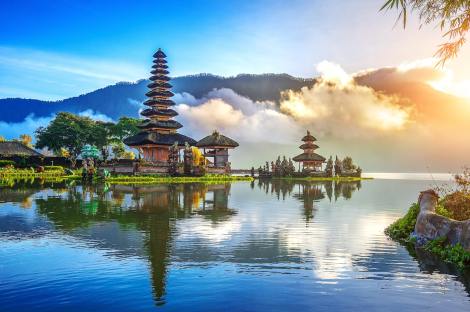
Lake Temple Of Pura Ulun Danu Batur.
ii. The Subak as a defining Balinese identity
Different from western notions of intensive agriculture and irrigation systems confined within set boundaries, the Subaks within different watersheds interweave together with neighbouring subak systems in an elaborate network functioning on exchange and mutuality (Huang, 2019; Rahmi & Setiawan, 2020). From water temples, rice fields to desasabound, the interlinkages between the subaks have become the foundational defining identity of Balinese life, interlocking socio-economic, physical, environmental, cultural, community, spiritual, village and family features. It is a challenge to extract and isolate any element of Bali life that is not affected by the subak. Overall, this highly revered processes intertwined with the subak is what contrasts Balinese rice terraces from other cutting-edge or olden irrigation styles found in the rest of the world (Groendfelt, 2003).
A most interesting fact highlighted by Huang (2019), demonstrates how the Balinese water temples goes against the viewpoints of Garette Hardin’s concept in ‘tragedy of the commons’ where natural resources are doomed to destruction when used by everyone. This is disputed by Elinor Ostrom by means of Balinese water temples that show that there are alternatives to resource management, when cosmology, customs and negotiation of values and principles can come together to articulate the complex systems in a resilient and peaceful manner. The uniqueness of Balinese Subakexceed normative ideas of resources, allowing Balinese rice farmers to be one of the highest rice yielders in Asia. Truly, the cohesive force of social fabric and religion juxtaposed unto the land is a show of a vibrant model of diverse and sustainable manner of natural resource management that other systems across the globe can learn from (Lorenzen & Lorenzen, 2011; Artha, 2005; Huang, 2019).
iii. Dawn of globalisation and the brush of neoliberal drivers: dilemmas faced by contemporary Subak systems
As mentioned above, the listing of Balinese subak as UNESCO designation has reshaped various dimensions of the landscape. More than anything else, to the world, the subaks landscape are simply a must-see tourist destination on the list. Over the last decade, the face of Balinese subak has dynamically altered with the flow of tourists and their increasing demands. In a study conducted by Rahmi & Setiawan (2019) it is observed that in 2015, Bali saw 164, 358 people arriving to the island, while 2017 witnessed a rapid rise to 250, 978 people. The changing functionality of the landscape to buildings including homestays and restaurants, threaten the integrity and ‘authenticity’ of the subak and the values it holds for the farmers and community (Rahmi & Setiawan, 2020). Along the main roads of the rice terrace areas, land has been purchased and converted into economic hotspots, altering the visual integrity of the landscape, and eroding the sacred quietness and pristine atmosphere to perform THK in the rice terraces. As a result of the confusing exchanges, the network of subak watersheds have shrunk, and smaller, isolated subak sites cannot prosper by itself, ending up being sold at the end of the day. The conversation of agricultural land under the rapid drive of urbanisation and globalisation is visually seen in the landscape: the main road from Denpasar to Tabanan have hidden away or removed any previous rice fields, replaced instead by businesses including hip-cafes, local stores, food stalls and massage parlours (Rahmi & Setiawan, 2020; Lorenzen & Roth, 2015).
Many farmers express disdain of the foreigners as it is uncomfortable to feel objectified as background props for photographs. Consequentially, many young people have become increasingly inspired by the thriving tourism sector, opting away from becoming farmers as it is now considered low-class and un-prestigious. The farmers say that their children are ‘malu’ (ashamed) or ‘malas’ (lazy) to participate – a thought-process exacerbated by the increasing desire of parents to have their children becoming educated enough to leave the rice terrace for a more stable livelihood. The shift of employment sees younger people moving into the service sector, including hotel business or cruise ship industries (Rahmi & Setiawan, 2020; Wardang, 2015; Lorenzen & Lorenzen, 2011).
iv. Shifting Management within the landscape
When the Green Revolution period took place in 1970, subaks were appropriated by the government as top-down edicts which resulted in the removal of self-governance and democracy where it existed previously (Huang, 2019). Furthermore, when previously, customary to the awig-awig, the Subak is headed by the pekaseh, induction as a UNESCO heritage site has introduced multiple players onto the management scene. A specific legal framework for the area has been established by a Memorandum of Understanding between the Government of Bali and Regencies of Bali for the establishment of the Strategic Area of Bali. Awig-awig have become written in legal codes, underlying regulations of Bali province Number 5 (2005) Section 19 that clarifies zoning for sacred sites. Additionally, decrees such as the Tabahan Regency Decree No 9/2005 and National Law No. 5/1992 are set to protect against large-scale tourism development and destruction of puras (Huang, 2019). Further coordination between the Balinese government and parties including the official villages, traditional villages, provincial governments, Tabanan regency, private sectors, local farmers, and landowners have become intertwined in the goal of protecting the Subak.
Theoretically, all of this may seem like a sound approach to handle the newfound international status, but reality-on-the-ground illustrate more conflicts than resolution; famers feel that there is no transparency in managing money from entrance fees, inadequate compensation of the use of their territories as tourist space, a dislike for the additional elements installed in the rice field area that contradict desa culture, and lack of communication of what UNESCO principles and standards of management expect, or may provide to the farmers (Rahmi & Setiawan, 2020; Huang, 2019; Wardang, 2015). The desecration of the economic dimension of ‘sustainable’ conservation to the local stakeholders result in dissatisfaction by the farmers. In all, the slack in enforcing laws, human resources, and financial management have highlighted a change in the landscape that has slowly integrated the ‘authentic’ principles of the once sacred space. The large number of stakeholders involved in the management of subak have destabilised the resilient element of the subaklandscape.
v. Land and Water Degradation and the Consequential Dismissing of Priests and Temples
With the changes in adjacent land use, the subak landscapes feel the pressure of change in waves. These waves come in the form of waste and pollution produced by the developments that clog the canals constantly. Once revered as sacred, blessed tirtha water, the waste produce has lessened the holiness of the water flow. As the canals are within munduk, the boundaries of the farmers, they are forced to bear the cost of repair and regeneration themselves (Rahmi & Setiawan, 2020; Ahuja & Ahuja, 2010; Huang, 2019). With the increased workload, more are tempted to give up rice cultivation, forgetting old devotional philosophies of THK, or channelling the practice elsewhere. Furthermore, the 1977 ‘Green Revolution Rice’ introduced by the Indonesian government to encourage short rotation rice varieties have led to a confusing reconfiguration of Balinese cropping calendars. As a result of this change, rituals no longer match schedules, leaving priests and water temples irrelevant in the face of traditional communal rice growing (Huang, 2019). The modern subak is no longer nostalgic of farmers association relying on mutual help and exchange. Everyone now possesses self-determined agendas and needs that are channelled elsewhere, while rice farming has become more of a side-hobby. Thus, the boundaries of rural and urban spaces have dissipated over the years (Lanya, 2017; Lorenzen & Lorenzen, 2005).
Should the Subak Rice Terraces be Preserved – What Can the Future Look like?
While many may argue that the surge of globalisation is too formidable to counter, there are many elements that showcase the resilient uniqueness and ‘unusualness’ of the Subak ecosystem that hold the potential to halt, or at least slow down the inevitable process of landscape change. The multi-faceted nature of the subak system represent the closest reflection of an organic ecosystem. The effervescent and diverse, ecologically sustainable, economically productive and democratic water management systems is a most elegant representation of Berkes (1989) social-ecological framework that operates on an amalgamation of religious symbolism and mythology that can spiritually motivate individuals to act, combined with the familiar customary awig–awig laws as well as THK that are embedded in the traditional Balinese life enables farmers to cooperate rationally through managing water distribution, with local wisdom and knowledge passed down from generations through rigorous trial and error efforts. The water distribution ensures a complete cycle, whereby the water returns to the river through the subak systems. Most of the water within the complex canal systems contribute largely to flood control, groundwater recharge and the mitigation of risks from soil degradation, erosion and landslides may pose a real threat to the mountainous region.
From the issues currently plaguing the rice paddy fields, it appears that minimizing land conversion is a vital step in addressing the issue. Taking into consideration that the locals have expressed that it is the enforcement of laws that are weak in upholding rules laid out to protect the UNESCO sites, it is therefore important to revisit the spatial planning efforts and ensure a stricter approach in ensuring the new policies are upheld. Indeed, urbanisation may be inevitable, but the pace can be controlled and regulated in the early stages to avoid undesirable effects. The rural-urban gap as discussed above in terms of career choice changes can be shrunk by improving rural infrastructure, providing rural transportation, educational institutions, and entertainment centres to balance rural-urban pulls and push, and encourage the youth to remain within the Subak landscape vicinities. The administration and management organization of the land has to be addressed as well. This can be done by empowering the farmers and irrigators with stewardship capacity building, and including them within decision-making spheres, not just as spectators but active voices.
While the pollution has seeped into the aquifers and sacred resources of the island, technology from the West supported by UNESCO initiatives can mitigate the impacts by conducting scientific hydrological studies to assess the current state of the ecosystem and introduce counter initiatives that can heal the ecosystem. On the other hand, one may even lean to the growing demands of tourism by reshaping and renegotiating elements of the Subak system that does not pose overwhelming risk. For example, as introduced by Lorenzen & Lorenzen (2005), perhaps it is the appropriate era to shift towards ‘organic’ agriculture, selling organic rice to strengthen the link between primary and tertiary sectors of Bali. As reiterated by the authors, this can result in Balinese rice cultivation as promoting not only the best farmer-based irrigation system, but also the ‘healthiest’ rice that follows the demands of globalisation shifts. With the revoking of the Green Revolution sanctioned seeds and chemicals in 1988, the subak water temples now have freer rein to grow rice as they wish.
Conclusion
In this paper, I have traced the history and cosmological importance of Subak irrigation system and its role in manifesting Tri Hita Karana. We have witnessed the landscape change over the years driven by the force of tourism and changes in socio-cultural norms. While the landscape has been unfairly negotiated to give in to contemporary changes that threaten the devastation of agama dharma and agama thirta practices, it is not too late for the tides to turn in the opposite direction and for the Balinese communities to take the new modifications into stride. As the case study of subaks in Bali shows, it may be difficult to navigate globalization forces without proper enforcement of laws and regulation but the same way that the subaks of Bali have recovered from the Green Revolution of the 70s, it too again may recover from the damages felt now.
References:
Ahuja, S.C., & Ahuja, U (2010). Rice in Social and Cultural Life of People. Rice Origin, Antiquity and History, S. D. Sharma. Boca Raton: CRC Press, 2010
Artha, I. W. A. A., Lorenzen, S., & Lorenzen R. (2005). Past, Present and Future – Perspectives of Balinese Rice Farming. International Rice Conference of 2005.
Bellwood, P., Gillespie, R., Thompson, G. B., Vogel, J. S., Ardika, I. W., & Datan, I. (1992). New Dates for Prehistoric Asian rice. Asian Perspectives. Vol 31. Retrieved from https://core.ac.uk/download/pdf/5105283.pdf
Berkes, F. (1989). Common Property Resources: Ecology and Community-Based Sustainable Development. London, Belhaven Press
Brabec, E. (2004). Landscape Change: The Influence of External Cultural Forces. Multiple Landscape: Merging Past and Present in Landscape Planning. Proceedings of the 5th International Workshop on Sustainable Land Use Planning Retrieved from https://scholarworks.umass.edu/cgi/viewcontent.cgi?referer=&httpsredir=1&article=1003&context=larp_faculty_pubs
Burgi, M., Hersperger, A.M., & Schneeberger, N. (2004). Driving Forces of Landscape Change — Current and New Directions. Landscape Ecology. Vol 19, pp. 857-868. Retrieved from https://core.ac.uk/download/pdf/159157274.pdf
Geertz, C. (1980). Negara: The Theatre State in Nineteenth-Century Bali. Princeton N.J: Princeton University Press
Groendfeldt, D. (2003). Multi-functional roles of irrigation with special reference to paddy cultivation. World Water Council 3rd World Water Forum, Kyoto, Japan.
Huang, Hao (2019) Nature and the Spirit: Ritual, Environment, and the Subak in Bali. EnviroLab Asia: Vol 3(1).Retrieved from https://scholarship.claremont.edu/envirolabasia/vol3/iss2/1
Lansing, J.S., & Kremer, J.N. (1993). Emergent properties of Balinese water temples. American Anthropology. Vol 95.
Lanya, I., Dibia, I. N. Diara, I. W., & Suarjaya D. G. (2017). Analysis of Subak Landuse Change Due ot Tourism Accomodating Development in North Kuta Sub-district, Badung Regency, Indonesia. IOP Conf. Ser.: Earth Environ. Sci. 98 012024
Lorenzen, P. L., & Lorenzen, S. (2011). Changing Realities —Perspectives on Balinese Rice Cultivation. Human ecolog Vol 39(1) pp. 29-42
Lorenzen, R., & D. Roth. (2015). Paradise Contested: Culture, Politics and Changing Land and Water Use in Bali. Asia Pacific Journal of Anthropology. Vol 16 (2). Retrieved from https://www.tandfonline.com/doi/abs/10.1080/14442213.2015.1006667
Mouat D. T, Peiser, R. & Shaerer, A. (2003). Alternative Futures for Changing Landscapes: The Upper San Pedro River Basin in Arizona and Sonora. Island Press, Washington DC, USA.
Rahmi, D. H., & Setiawan, B. (2020). Pressures on the Balinese World Cultural Landscape Heritage. IOP Conf. Ser: Earth Environ. 501 012032
Rawlinson, C.W. (2017). The Routledge Handbook of Food Ethics. Abingdon UK: Routledge
Roth, D. (2011). The Subak in Diaspora: Balinese Farmers and the Subak in South Sulawesi. Human Ecology. Vol 39 pp. 55-68.
Sergeant, A. (2002). Human and Ecological Risk Assessment. John Wiley and Sons, New York, New York, USA
Sutawan, N. (2000). Negotiation of Water Allocation Among Irrigators’ Associations in Bali, Indonesia. Negotiating Water Rights, New Delhi: Vistaar Publications and International Food Policy Research Institute
Sutawan, N. (2004). Tri Hita Karana and Subak: In Search for Alternative Concept of Sustainable Irrigation.Retrieved from https://www.maff.go.jp/j/nousin/kaigai/inwepf/i_document/pdf/sympo_sutawan.pdf
Wardana, A. (2015). Debating Spatial Governance in the Pluralistic Institutional and Legal Setting of Bali. The Asia Pacific Journal of Anthropology. Vol 16(2)
 zulaikha Ishak