by Dk. Siti Zulaikha Pg Hj Ishak
Ethnographic exercise submitted to NUS.
Photos by author.
On the choppy wooden boat, I squint at the scenery through the lens of my camera, trying to not fall into water. The gleaming dome atop the royal palace peeks unassumingly through the foliage. Here, the seat of government is perched fittingly at a high point along the riverbank. It is a bold symbol in a city where height is an expression of status; a city where no buildings may erect higher than the capital mosque. For now, the shining dome only seem to worsen the heat. I fan myself with my hand, wiping the sweat rolling down my back and between my thighs. It’s a standard sticky day in the tropics. Across the riverbank, just a 29-second boat ride away, dilapidated floating houses of Kampong Ayer draw a breathtaking contrast. Come high tide or low, wet monsoon or dry, components of the scenery are non-negotiable: the mangroves, the king’s abode, and the olden houses a kind of archetype for the foundations of the Brunei world.
In quiet moments, the floating houses are reflected in the canal’s murky water, through which tangles of twigs, plastic fragments, and the occasional soiled diaper eddies never-endingly, leaving a trail of dirty foam suggestive of detergent soap. The air itself stings you – the fetid river breeze pierces one’s nostrils unforgivingly. It’s hard to describe: it is a mix of shrimp-paste, mud, decomposing fish and urine. A few men can be seen braving the stink, staking their fishing lines on the edge of their boats. Guffaws of laughter an endless noise from their end. I wave nonchalantly as we importantly hurried past, the river mist pooling on my face. I lick my lips for the full experience. River flavour.
At the hub of the aquatic centre, sudden raucous rattles of timeworn engines shatter the muggy calm of day as boat operators call out and whistle to potential passengers. Painted on the sides of these boats, in a cheeky air of je ne sais quoi are the names: from Quicksilver, Yamaha Srirocco, to Stone Cold Crazy, Budak Nakal (naughty boy), alongside traditional female names, including Isabella and Noorasima. Local folks step gracefully onboard, some smartly dressed for work, side by side with uniformed students, their white attire reflecting sharply in the sun. Not to be dismissed (or dismissible in any case), shiny clad tourists, clambering clumsily onto the narrow boat landing. Mixtures of different dialects, language sift through the air. Splish splash, and further splashes – the acoustics of life here, a never-ending buzz.
My boat journeys further down the channel where the river unravels, engulfing the banks in its entirety. Around me, the boat operators are fewer – the only company is the murky brackish water making its journey into the bay. It is a sight to be reckoned with, a stillness to be respected. We are closer to the source of mud and life now, the stink sharpening and permeating my clothes and hair, though I am no longer crinkling my nose and blowing out sharply (have I gained the boatman’s respect yet?). Before I can fully grasp the sublime wideness of the channel, Nypa Fruticans appear and flock the sides of the river. Mangrove systems, both Avicienna and Sonneratia dominate the landscape in all its glory. The system waves with the wind, a dramatic welcoming scene for the city-folks. On the emergent tree-tops, herons are poised in heraldic presence. Flying foxes camouflaged in the dark foliage keep a wary distance of visitors, while the endemic proboscis monkeys swing vine to vine, howling into the still air. I glimpse a mother – a baby! – more mothers! – and finally the long-nosed male, leader of the harem swaying in the shadows. Once again, the acoustic rumbles return – but differently here.
Here, in a private pocket of the island, the sense of antiquity overwhelms me. The seemingly pristine wetlands present themselves not unlike a museum; a living landscape showcasing biological miracles. The jungles of Borneo have existed for nearly 130 million years, making it one of the oldest on the planet, generating and regenerating itself over epochs. And perhaps not as old, but so too do the folklore and beliefs held by the visiting populations permeate through the decades: “Buaya putih (the white crocodile)”, my boat-driver begins, “do not roam these waters anymore. He’s too old and blind now, after defeating the Sarawakian buaya putih decades ago. But who knows… it could be our lucky day… he might just be underneath the boat right now, listening in.” His drawling voice reflected his boredom in the retelling. The legend of the white crocodile is a story I’ve heard as a child, a tale repeated to every wide-eyed tourist to hop on a tour boat (which is essentially any boat, with the right price). Tales of an enormous white crocodile that was supposedly sighted in the past have been decorated with mystical associations and magic – and who knows – it might have actually been an exceptionally large albino crocodile – but factual or otherwise, these stories keep the olden societies alive. Beliefs shaped years ago remain practiced today: it is evident in the age-old mantras chanted by the boatmen and fisherfolk alike, by the placentas drifting downstream and in biscuit tins, and by preserved sites across the bank, including the royal mausoleums found in the channel’s nooks.
Indeed, kampong Ayer concentrates historical significance in its small space: the looming golden dome of the Royal Mausoleum’s jetty sent goosebumps down my spine. It is an arrestingly unusual scene in the thick and dense wetland, almost an ominous sight – but it is also symbolic of the sacredness that saturates the space. Most pointedly, it suggests the longevity of Malay Muslim lineage of the island and the extent of their control, even through the isolated and deafening wilderness. Truly, the space is a lingering trace of the old polity. As it is here that the civilization of Brunei and its first axis sprung, it is not difficult to feel the presence of old ghosts in the mystical river, in the trees. It is here still that we can witness the barely perceptible wisp trailing the fading echoes of memory into the unfamiliar smog of modern Borneo. But smog or not, today I content with the shrimp-paste-diaper-muddy scent as we sped further in the channel.
(Attached below are some photos I took of the site last year if one is curious to put pictures to words).
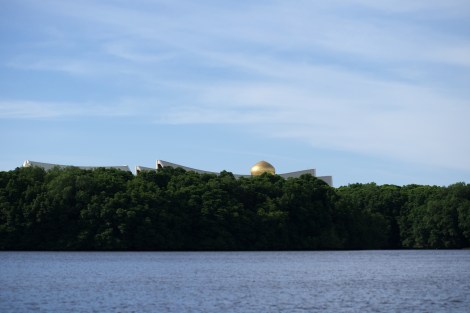
A glimpse at the seat of government: The gleaming dome atop Istana Nurul Iman peeks unassumingly through the foliage.
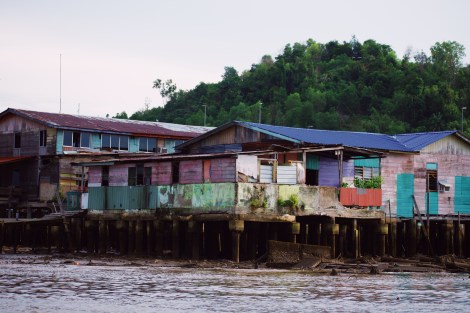
Across the riverbank, a 29-second boat ride away, dilapidated houses of Kampong Ayer draw a breathtaking contrast. Yet historically, it is here that Brunei’s civilization once sprung; it is here where the first sultan of Brunei, Sultan Muhammad Shah established the Sultanate in 1363. The de facto capital was greatly revered as the nucleus of power that administrated from Borneo, all the way to the fringes of what is now Philippines. In fact, Kampong Ayer held the honourable status of “Sungai Kerajaan”—belonging to the sultan and royal family.
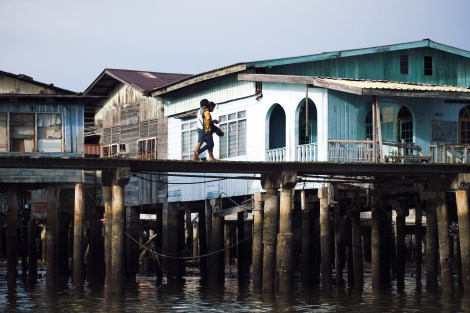
Shell of glory: It does not take long for one to observe that grandeur days of Kampong Ayer have long passed. Rapid urban growth since Brunei’s 1984 independence from the British power greatly reconfigured the face of Kampong Ayer to a far cry from what it was before. Schools, fire brigades, police stations, clinics and mosques scatter the landscape: a suggestive nod to progress and self-contained sufficiency. Yet, urban planning strategies have done little to ensure this continued security – national masterplans designed over the past four decades have been positioned at two highly opposing approaches. The first plan, Negara Brunei Darussalam Master Plan (NBDMP) of 1986 mandated for decentralization away from Brunei’s capital to pursue polycentric development of the district’s periphery, whereas the second iteration, National Land Use Master Plan (NLUMP) of 2006 raised alarm on the potential inability to regulate land-use, refocusing urbanisation plans back to the central district.
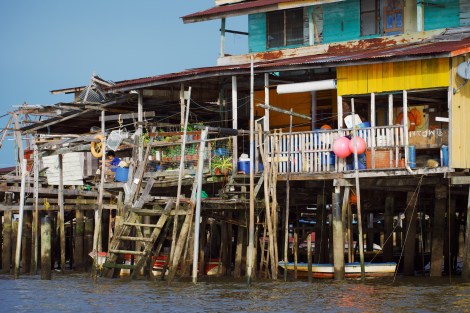
The lack of a cohesive vision exacerbated by disorganised ministerial departments and opaque jurisdictions have resulted in an undeniable urban decay of Kampong Ayer and the surrounding city centre, one rife with high unemployment, drug issues and an overall low quality of life – a decay that is as conspicuous as it is unaddressed.
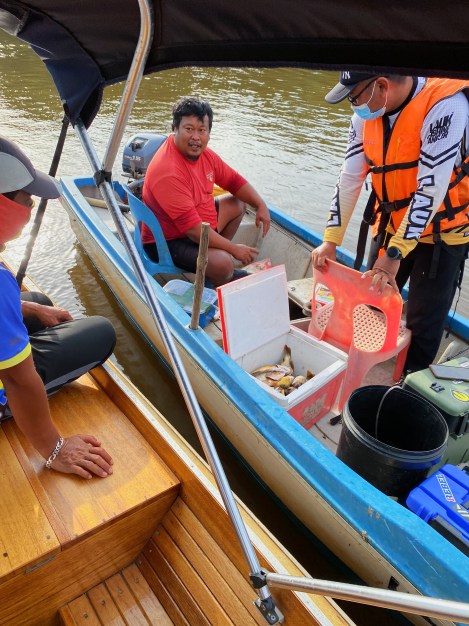
A dwindling economy: Where half of the country’s population lived on the water just a century ago, now only 3% of locals call it home – its slow deterioration a symptom of depopulation, emigration towards land as well as a steady decline in fish stocks, a former income for the local economy. Residents are strictly limited to small-scale fishing, now a scanty hobby for most. From dusk to dawn, handful of fishermen try their luck in long wooden vessels. These boats have evolved through the years to withstand the buzz and fuss of choppy surfaces. Gone are the rowing days — these boats now come to life by high-powered engines, at times even equipped with GPS. Photographed above: fishermen in a nearby boat gestures jovially towards a cool box — juvenile mangrove snappers gleam vibrantly in the sunlight. He offers one for $7.
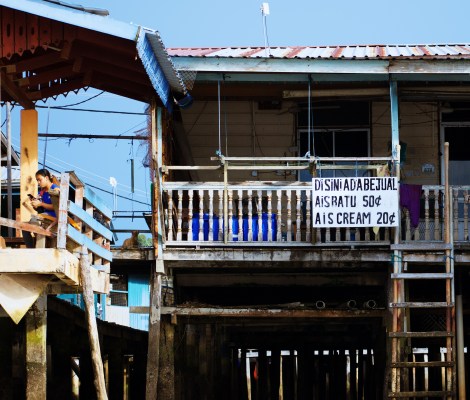
Picture reads: “We sell ice for $0.50; ice-cream for $0.20.”
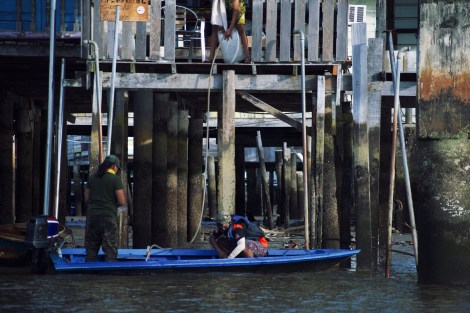
A man lowers down a rubber tube to fuel up a client’s boat engine in the picture. Just a few decades ago, the acoustics of life was much more layered: traders negotiating fresh produce and provisions on paddle boats, weaving rolls of fine Jong Sarat cloths, the grinding and chiselling of boat-makers and silversmiths filled the air. Nowadays, only the soundmark of motorboat engines dominate the soundscape.
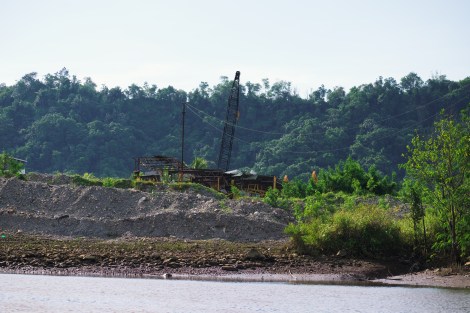
The crying river: fragments of unprotected mangrove systems along the banks have resulted in irreversible loss and degradation of the overall ecosystem. Furthermore, the estuary receives major portions of the capital’s stormwater runoff which drains continuously into the Brunei Bay; sewage joins the flow, creating a polluted ‘sink’ that receives all natural and human-related liquids, solids, and gases. Local volunteers (Save Kampong Ayer) collected 244kg of waste from the area this year in April alone.
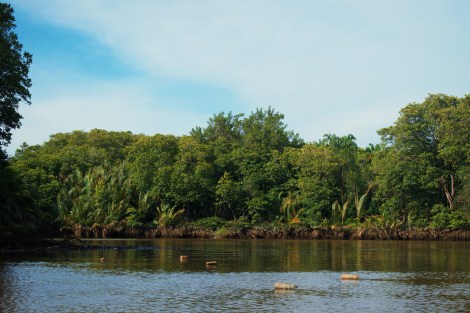
In pictures: a segment of the mangrove reclaimed to make way for residential housing on land; plastic bottles litter the inner banks of the river.
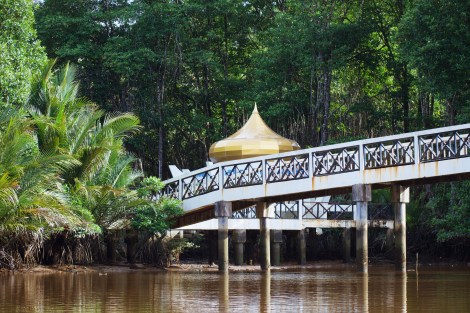
Through history: In 1968, post-colonial construction of “Malay, Islam, Beraja’ (MIB) as the national philosophy was embedded in political discourse. It bolstered the Monarchical system with racial and religious worldviews to legitimise Brunei as a nation state. Hitherto a subaltern space, Kampong Ayer was immediately upgraded as a cultural space to be protected, central to preserving the image and ‘imagination’ of the Malay national identity. Narratives and myths alleviated the ease of an imagined community there, where Bruneian identity was promoted… but which Bruneian? The first census of Kampong Ayer held in 1911 recorded 96% of “Malay and Indigenous” occupants. To lump the residents under an ambiguous ‘Malay/indigenous’ category was not a fair observation: each of the 35 sub-villages within Kampong Ayer held their own ethnic identity and heritage despite existing under the polyethnic umbrella of ‘Malay’. Furthermore, Indonesian residents were driven out of the area as only Bruneians were now allowed land ownership; yet the contradictions of resettlement programs pushed for Kampong Ayer residents to move inland. When they did move, they were referred by the inland communities as the others, or ’poklen’ – a local label to denote unruly, uncivilized, and low-class individuals. So, who exactly are the Bruneians to be ‘preserved’ and protected?
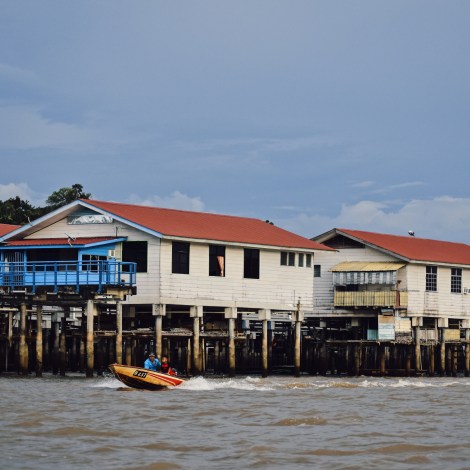
Incompatible housing schemes: Two housing schemes dominate Kampong Ayer – Kg. Bolkiah A and Kampong Bolkiah B, as shown in the pictures above. Different from the old wooden houses built at random, the new buildings are cemented, with concrete pillars and walkways. Residents across Kampong Ayer are invited (though in most cases, are forced) to resettle. One cannot help but reminisce on Foucault’s ideas of power as ‘biopower’ and biopolitics of population; as living conditions transition from an individual style to one that is collective, designed through modes of controlled organization, one that is expected to yield productivity.
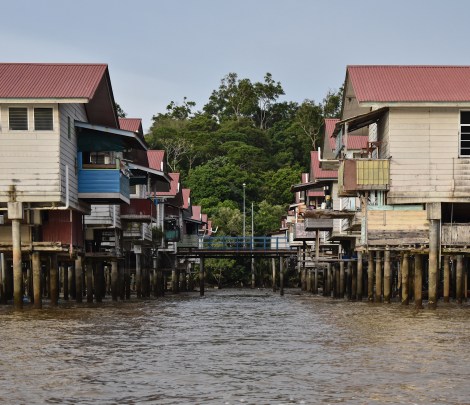
Yet, through interviews with residents of the housing scheme, it appears that most are dissatisfied; the organised spacing was not natural to their ‘traditional’ way of life. Neighbours spoke and mingled infrequently, a sharp change from the social setting of the previously intimate and haphazard dwelling arrangement. Thus the sense of trust and help within the community, key values prided within Malay communities have declined sharply, at times non-existent. One must wonder if the decline in ‘Malay ideals’ are considered at all during dialogues of selling Kampong Ayer as the authentic image of Brunei.
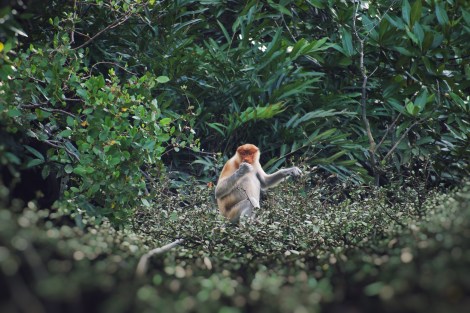
The natural dimension: The ecology surrounding Kampong Ayer itself is an irreplaceable wetland system, housing a pulsating array of rhizophora and nypa species, endemic proboscis monkey of Borneo, mangrove cat snakes, migratory birds as well as large specimens of saltwater crocodiles among many others — only two months ago, a four and a half metre long saltie was netted in the area.
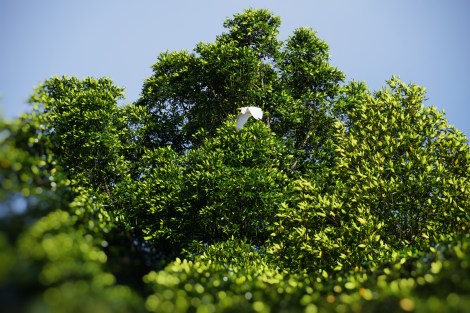
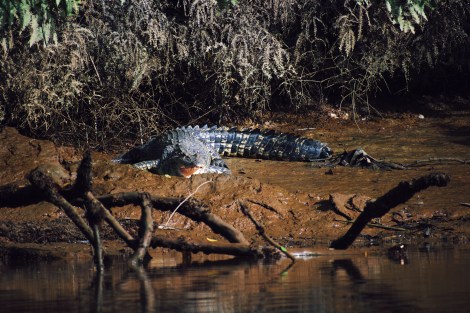
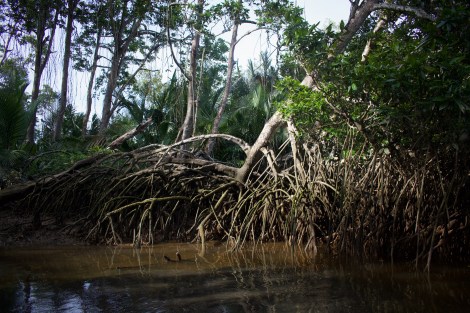
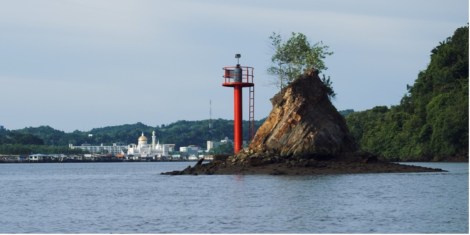
As other economic avenues are limited, ‘tourism’ (casual boat rides) along the mangroves is the main attraction of the area. This avenue has yet to be formally capitalized and structured, but perhaps it better that way. Locals use this opportunity to liberally relay their ‘scientific’ knowledge of the area, as well as the socio-cultural/spiritual stories and practices there. It is not uncommon to hear them lament about Buaya Putih (the mythical white crocodile) and Jong Batu (the legend of an unfilial son, Nakhoda Manis, who was cursed by his mother into stone along with his wrecked ship, as depicted in the jutting outcrop of the picture below).
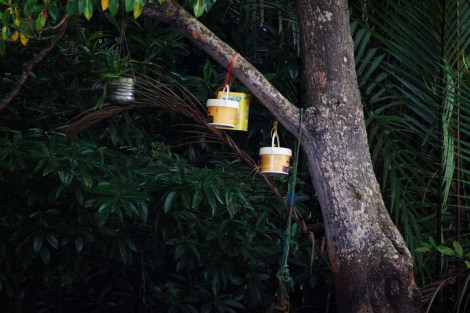
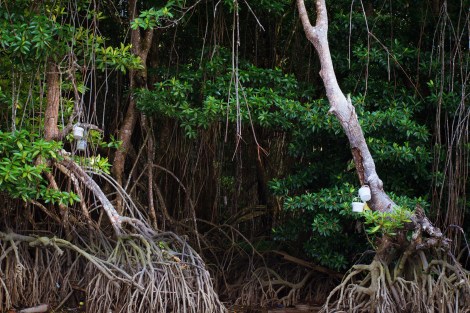
From womb to tree: For residents of the village, the mangrove system pose as an extension of their identity: along densely populated sections, paint-buckets, and biscuit containers perch precariously on branches. They store placentas of new-born babies; a spiritual ‘beacon’ for the individual to ‘return home’ when he/she dies. Animistic customs of past ancestors still manifest today, at times through subtle agencies, or in blatant displays as these. Previously suspended within cloths, these expressions of spiritual belief have adapted to the dynamic changes of external globalization forces – adoption of plastic permeates even in most private spiritual practice, is one such visible example. On less common occasions, placentas are left to drift along the river in a ritual called ‘dihanyutkan’ or sunk with stones down to the riverbed. It is undeniable that the interweaving relationship between the residents and the ecosystem are rooted deeper than material dimensions. Beyond waterscapes, residents that have migrated on-land now opt to bury the placentas in their backyard.
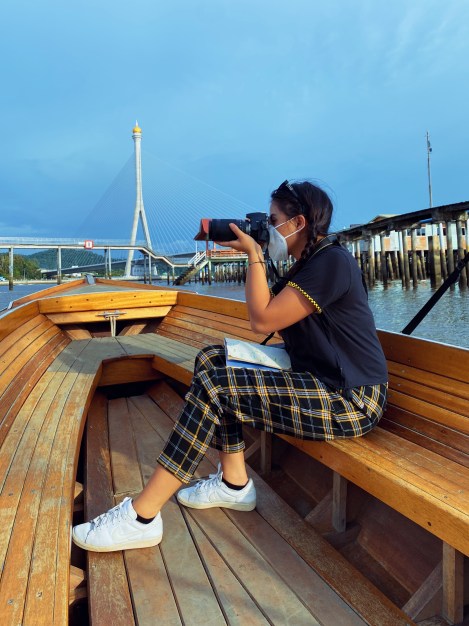
Final picture: author with the Queen’s Bridge in the background, the world’s second longest single-pylon cable-stayed bridge. Completed in 2017, the landmark was set to be an iconic part of the capital’s skyline. Olden Kampong Ayer houses litter the base. Once a glorious hub of Brunei Darussalam, Kampong Ayer is now seen as an ‘antique’ and static landscape, crippled by modernisation and social immobility. In pictures, (as may have been done in this very essay), the area often run the risk of being overly simplified, one-sided, or as what Sionbhan Lyons (2018) describes as ‘ruin porn’ for those obsessed with decay aesthetic.
The representational and non-representational dimensions of the area contrast to a significant degree, but future masterplans of the city that demand for the site to remain aesthetically ‘archaic’ refuse cognizance of the reality that space is never fixed, never dead, but possesses a multi-dimensional existential being that needs deep considering during urban planning.
This top-down mindset has left the natural resources of the area largely unprotected. Few occasions do the residents have a say in these negotiations – to decide what the landscape is supposed to symbolize once and for all. In a country as young as Brunei, understanding the ramifications of such clench-fisted implementation of planning is important to decide the long-term changes that the people wish to see. In personal introspection, for a country as small as Brunei, and with so few ‘remarkable’ landmarks compared to its Southeast Asian counterparts, I can understand how I, myself am naturally inclined to refuse change and desperately cling to a piece of past that may define my indigenous identity. To reorganize and reconfigure such emotional and historical sites can be paralyzing; to change, or not to change?
And how?
Perhaps only time (and the great monarchical hand) can decide.
—————-
Lyons, S. (2018). Ruin Porn and the Obsession with Decay. Springer International Publishing
Foucault, M. (1976). Volume One, The Will to Knowledge. Editions Gallimard
Asiyah Az-Zahra Ahmad Kumpoh. (2020). ‘Masuk Melayu’ in the Context of Conversion to Islam. BITARA International Journal of Civilisation Studies and Human Sciences. Vol 3(3), pp. 83-94.
 zulaikha Ishak